William Tyndale, Revisited

About 15 years ago, I began reading this book, and I filled its pages with post-it notes because I found it so interesting. My days were focused on homeschool and babies, and I couldn’t finish it before it was due at the library. Defeated, I pulled the post-it notes from the pages so I could return it, and I made a promise that I would pick it up again when I had more time to devote to such a scholarly work. Well, I remembered my promise and finished it.

There are other books that might tell the story of William Tyndale in a simpler way. This was academic, sometimes over-detailed, and occasionally beyond my understanding.

William Tyndale is one of my heroes. He was the first person to translate the Bible into readable, understandable English from the original Greek and Hebrew. He was condemned as a heretic and killed before he could finish his translation of the Old Testament. Thankfully, his New Testament and Pentateuch were used in the King James Version of the Bible after his martyrdom.

I liked the author’s focus on Tyndale’s value as a translator, comparing many more muddled translations to Tyndale’s direct, clear sentences. Tyndale contributed a lot to the English language, its cadence, sentence structure, and vocabulary. Beautifully and heroically, Tyndale made the Bible understandable, and its sentences memorable. He created important words and phrases such as scapegoat, Jehovah, and living water.

Take a look at the Bible, and you will see that most sentences are constructed with monosyllables, with multisyllable words at the end of the sentences for emphasis. This is Tyndale’s voice. His words sing in our minds. These are his words, and the King James Version follows them very closely.

And after the fire, came a small, still voice.

Why halt ye between two opinions?

Blessed are the pure in heart, for they shall see God.

So the last shall be first, and the first shall be last. For many are called, and few be chosen.

And Jacob served seven years for Rahel, and they seemed unto him but a few days, for the love he had to her.

Tush, ye shall not die.

He believed the Bible should be read by anyone, and the gospel defined by the whole book, not isolated phrases, or worse, commentaries. As he worked over many years on the New and Old Testaments, he came to understand the gospel in terms of a covenant relationship with God, requiring faith and action. He learned for himself the value of the word of God, taken in its entirety, to understand what God expects of us.

What he did took great skill. He knew 8 languages. What he did took great courage. He lived in hiding in a foreign land for years. You may have heard his quote to a learned man,

If God spare my life, ere many years I will cause a boy that driveth the plough shall know more of the Scripture than thou dost.

Moving beyond the book, I think about Tyndale’s influence on the plowboy, Joseph Smith, who translated the Book of Mormon. Joseph didn’t have an Oxford education like Tyndale. He had no experience in ancient languages, but with the inspiration of God and a mind full of Biblical phrases (influenced by Tyndale), he translated the Book of Mormon in a very short period of time. As for the words from James 1:5-6 that inspired Joseph the plowboy to go the woods to pray, many are Tyndale’s.


Mother’s Day Table

Richard took these photos of our Mother’s Day table. πŸ’•

I used flowers from our yard and photographs of our mothers and grandmothers to decorate the table. Richard did most of the cooking, and it was a delicious meal.

Smoked chicken

Mashed potatoes

Green salad

Homemade fan rolls

Eclairs

Apple pie with whipped cream

We had nine at the table tonight, including my parents, and we were joined by Tim in a video call after dinner. πŸ™‚πŸ™‚πŸ™‚πŸ™‚πŸ™‚πŸ™‚πŸ™‚πŸ™‚πŸ™‚πŸ™‚ Ten happy faces.

We had a Mother’s Day show and tell, where we could tell a memory or show an object to represent our moms. I loved hearing what people shared, even though I realized late in the game that some anecdotes were going to be about me. It’s funny, but I don’t really think of Mother’s Day as being about “me.” It felt good to have my mom here to celebrate her.

27 Years

Falling in love, like having a baby, runs against the current of our lives: separation, loss, and death. That is the joy of them.

Annie Dillard, Maytrees.

Walking and Talking

We’ve reached a moment of decision in the Old Testament curriculum this year. Before now, we studied every chapter, but recently, we began to move ahead more rapidly, with only selected chapters to read. I had to ask myself, “Will I read all, or just the assigned chapters?” I have decided to read ’em all, because I can.

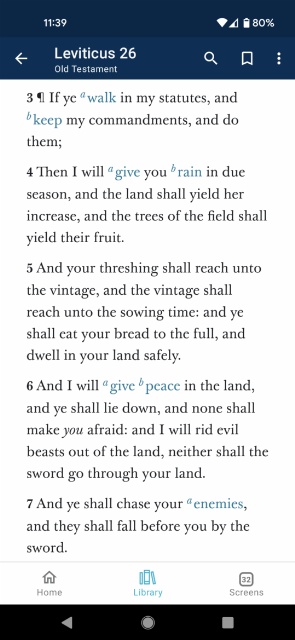
So, today I studied Leviticus 26, even though it wasn’t on the list. If you have a minute, Leviticus 26:3-13 is really worth reading. It’s basically a list of promises to covenant Israel.

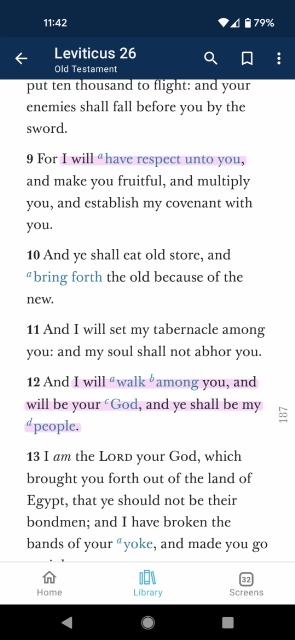
Take a look at the Hebrew footnote “a” in verse 9. It says the Lord will “turn unto” his covenant keeping people. This image is beautiful. All of these verses teach me that he is attentive, protective, and wants to walk among us.

I love that the Lord promises he will “walk among” us! To me, this indicates the need to be with other covenant people. If I surround myself with people of faith, this also increases the Lord’s influence on my life. For if he is inspiring me, he is inspiring others of faith. This is one reason I attend church. The most important reason, though, is to maintain my personal covenant relationship with God.

When I think of the Lord walking with me personally, I think of the steep roads I must climb. He is there. I think of the times I get hurt. He is there. I think of the confusion I feel sometimes. He is there, teaching me. After all, what is a walk without conversation?

My hope is to be able to hear him and notice him better among those of faith, and in my own private reaching. It’s not a question of him being there or not. It is whether I will recognize him. He keeps his covenants.

Not pictured

Not pictured are the friends I meet with each month to sew. These friendships and conversations are the real treasure from my time quilting, not the blocks and quilts.

When I see a project, whether it is a room I have painted, a sewing project, or piece of art, it often triggers memories of the circumstances when I created it.

These blocks, once sewn into a quilt, will probably remind me of long, important conversations, delicious snacks and meals shared with these friends, and their righteous influence in my life.

Colorful life

This past week we had Paige and Michael in New York City, Timothy in Vancouver, Daniel in Provo taking finals, Mark with friends, Richard downstairs, and I… in my usual chair.

Actually, there is a lot more to it. Adjusting and growing are tasks that aren’t always visible or noteworthy. I see each member of our family making great progress in many areas.

I am kind of circling in flight lately. (See this post.) Perhaps you, too, are in a time of adjustment. If so, let’s not be too hard on ourselves or too harsh in criticism of the situation. Let’s trust the process.

Discipleship in the days following Easter

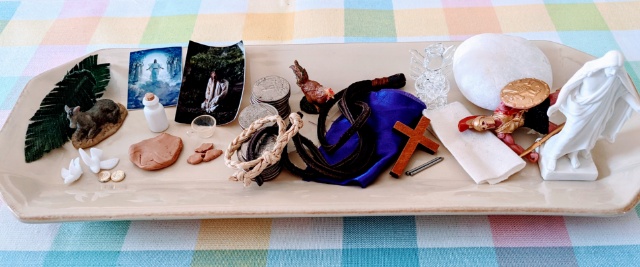
Holy Week teaching tools

Each year during Holy Week, we repeat our tradition of reading scriptures and setting out objects to remind us of Jesus Christ’s last week.

This year, my thoughts kept returning to Peter’s three denials of Christ. He really messed up here!

On Easter evening, we listened to the words of John 21:15-17 in a song,

15 ΒΆ So when they had dined, Jesus saith to Simon Peter, Simon, son of Jonas, lovest thou me more than these? He saith unto him, Yea, Lord; thou knowest that I love thee. He saith unto him, Feed my lambs.
16 He saith to him again the second time, Simon, son of Jonas, lovest thou me? He saith unto him, Yea, Lord; thou knowest that I love thee. He saith unto him, Feed my sheep.
17 He saith unto him the third time, Simon, son of Jonas, lovest thou me? Peter was grieved because he said unto him the third time, Lovest thou me? And he said unto him, Lord, thou knowest all things; thou knowest that I love thee. Jesus saith unto him, Feed my sheep.

In perfect mercy, Jesus allows a great reversal, offering Peter the opportunity to affirm his love for him three times.

With each “Yea, Lord,” and, “Thou knowest that I love thee,” the denials are overcome, one by one.

In the days following Easter, I want to remember Peter’s story of denial, and his story of reverting to fishing when Jesus left. Most of all, I want to remember the reversal that Jesus made possible for him. Peter’s story could be anyone’s story. No one is perfectly loyal to Jesus. Everyone can accept Christ’s mercy, repent, and get (back) to work feeding the sheep. That is just what disciples do.