New name, expanded purpose

In Genesis, we read about God changing Abram and Sarai’s names when they make a covenant with Him. The name changes seem slight, but they indicate a huge leap in purpose and influence. With a shift in a couple of letters, God shows that He has very big plans for them.

Abram became Abraham, and with those two new letters, the meaning of his name moved from “exalted father” to “father of multitudes.”

Sarai became Sarah, and with that change, “my princess/ woman of strength” grew to “princess/ woman of strength to many.” (Concepts for these names are from the Israel Bible Center website.)

This ancient story becomes our story as we make covenants and become “numbered among the people of the first covenant,” (Mormon 7:10) which began with Adam and Eve. God intends the same thing for us as He did for His ancient covenant people,

I will bless thee…

And in thy seed shall all the nations of the earth be blessed; because thou hast obeyed my voice.

Genesis 22:17-18

Just as He gave new names to Abraham and Sarah, I think that the Lord continues his mighty work through small and symbolic changes. As I look back on my life, my covenants with Him have set me on a journey that requires me to move beyond self into a larger area of influence, one mothering moment, one calling, one chance at empathy, one apology, and one change in personal philosophy at a time.

At baptism, and each week during the sacrament, we show our willingness to take upon ourselves Jesus Christ’s name. Truly, His Name gives infinite potential and purpose to our lives.

Harden Not Your Hearts

“Harden not your hearts”* is a phrase I read today in the book of Jacob, and I began to think about the control we need to exercise over our thinking.

Recently, I started to feel a little bothered by someone. “This person just wants me to feel small,” I thought. But then these two simple words came to my mind,

“Or not.”

Or not? The Spirit was teaching me to question my thinking. I was making assumptions. I was taking the easy bait of victimhood. I was hardening my heart. I was not giving the person the benefit of the doubt. I was wrong!

It is a common tendency to trust thoughts and feelings as though they are pure truth. Sometimes thoughts can be wrong because they might be influenced by emotion, popular philosophies, low blood sugar, fatigue, unhealthy family patterns… So much static.

My wisdom for the day is that we can be fooled by our thoughts. Measure your ideas with the standard of Christ’s doctrine. For me, the words “or not” were enough to help me see that there was a better way to look at things.

Our thoughts matter because they lead to action. Our hearts matter because they represent our loyalties.

“Harden not your hearts” is great counsel.

*See Jacob 6:5 in the Book of Mormon. See also Obadiah 1:3, “The pride of thine heart hath deceived thee.”

Which one are you?

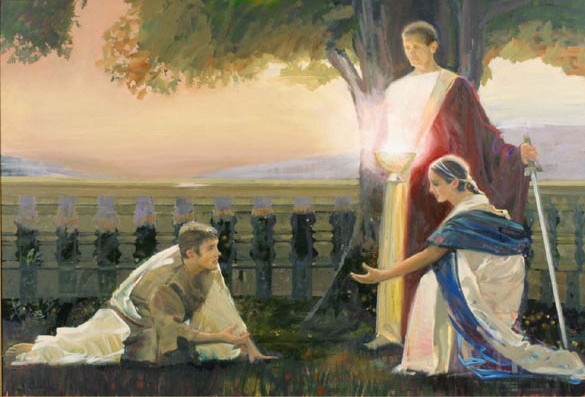
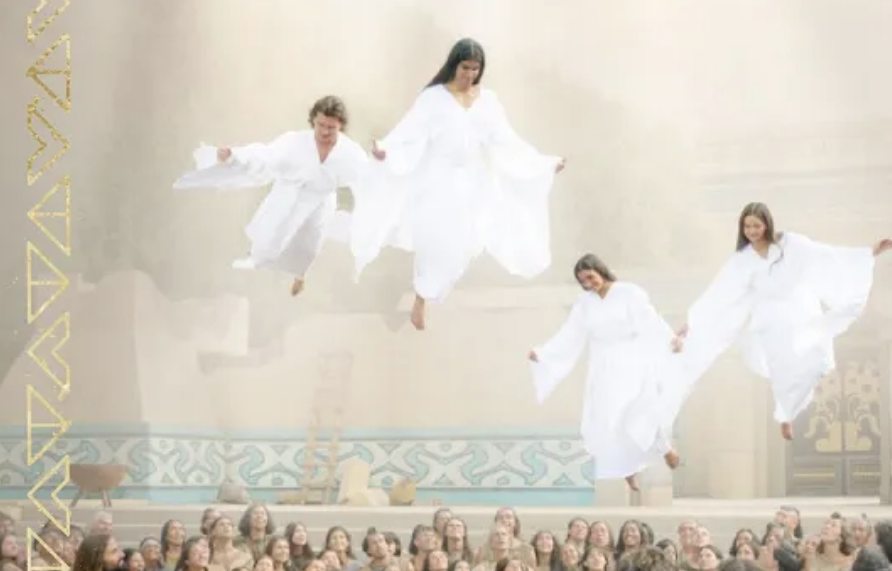
This film is a depiction of the Savior Jesus Christ appearing to the people in the Americas from the Book of Mormon.

I have three questions for you to think about.

Which person in this short film responds in the way that you would if Jesus came to visit you today?

What do you learn about your personal relationship with Jesus Christ as you watch?

How will you share His love with others today?

Assist and witness

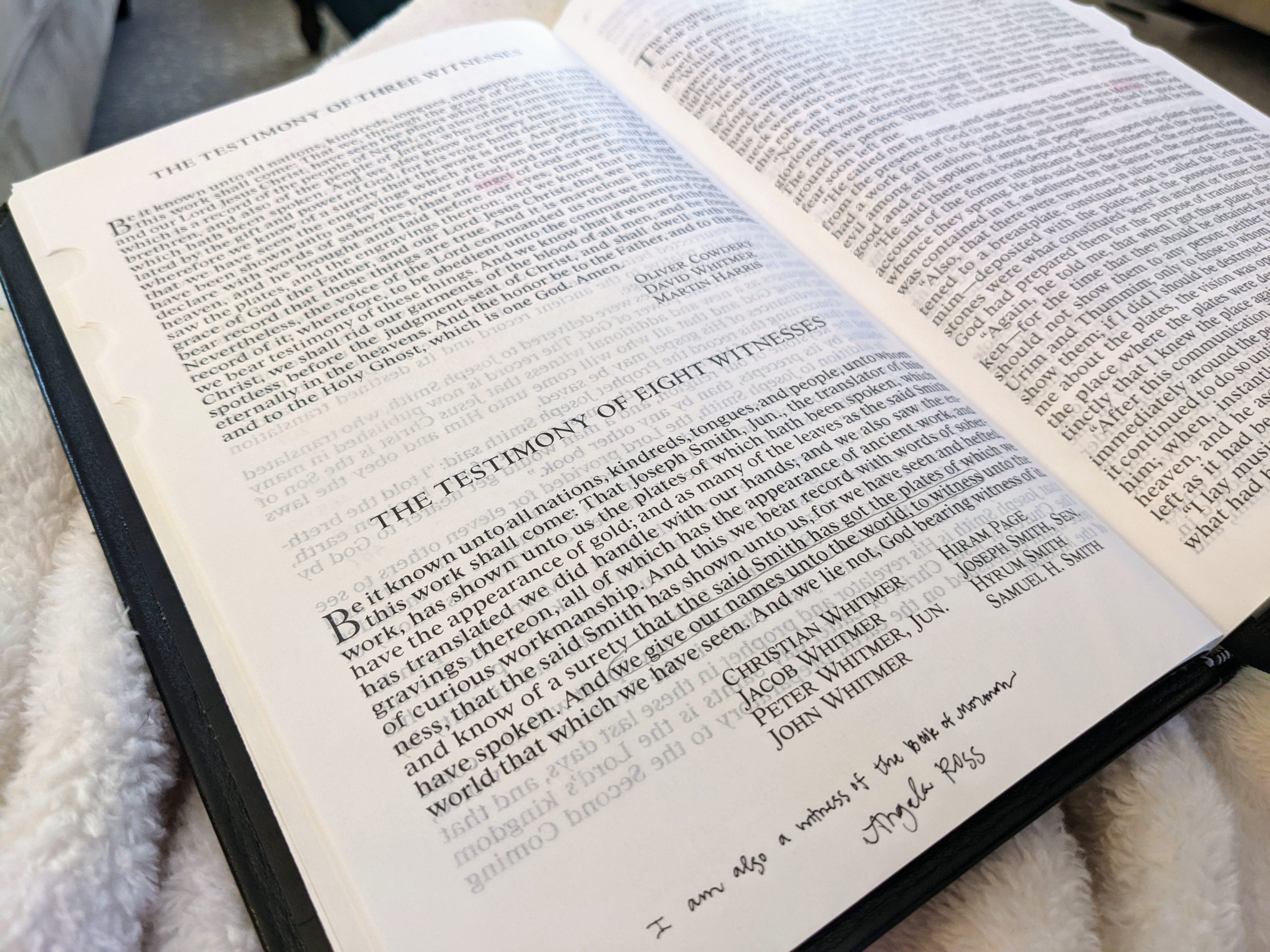
I listened to a class where they introduced the idea of adding your name to the witnesses page of the Book of Mormon. I thought it was a great exercise.

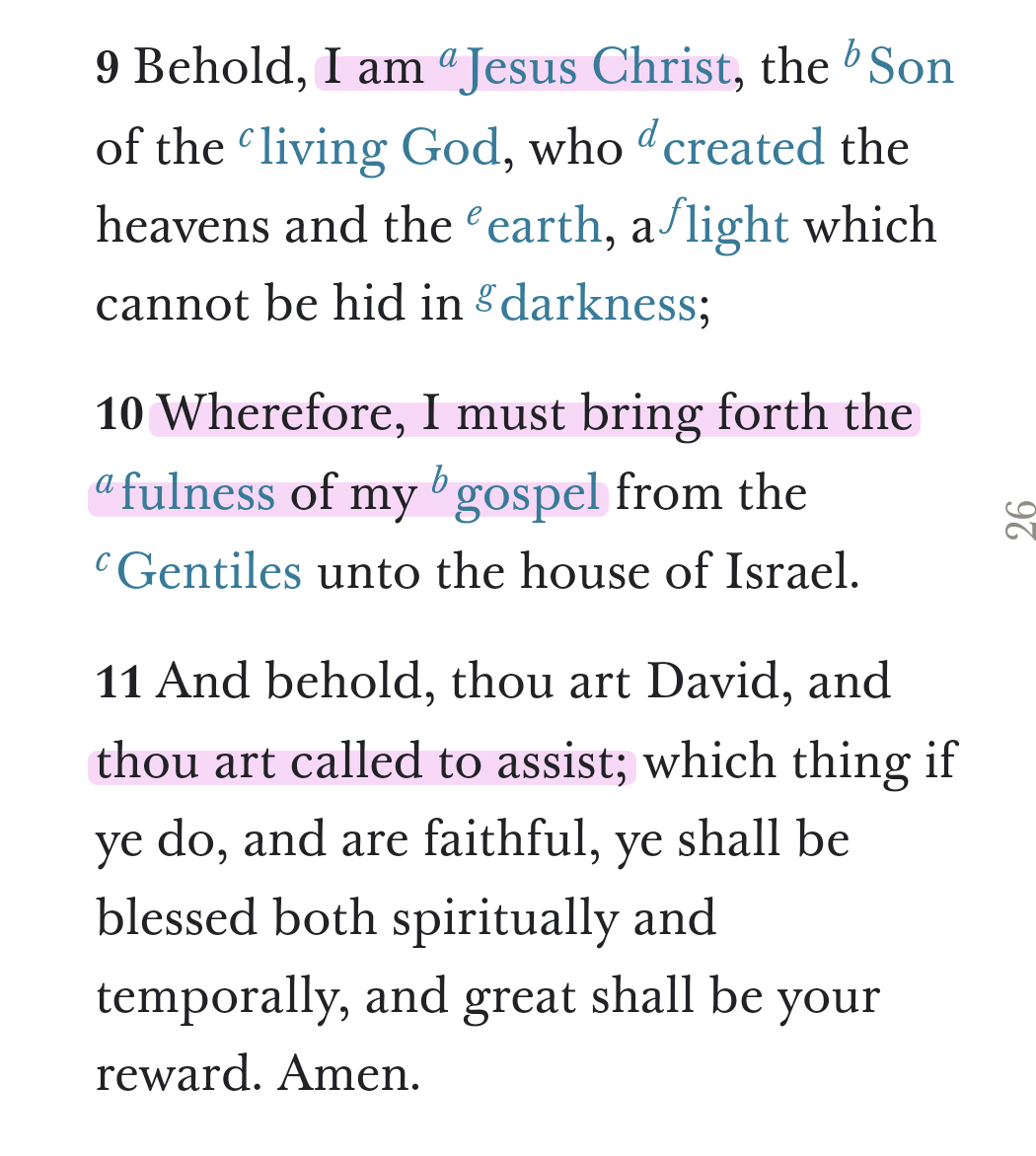
The following verses drew me in this time as I read Doctrine and Covenants 14, directed to one of the 3 witnesses of the Book of Mormon.

Maybe I needed a reminder of how much Jesus drives the work to spread His gospel. Maybe I needed the reminder that He asks people like me and you to assist for our own good. Maybe I needed the reminder that God’s chosen method to make things known is person to person, one by one.

With one accord

“It must needs be that we should be led with one accord to the land of promise.”

1 Nephi 10:13

I never considered this line from Lehi until today. He has seen a lot of disunity in his family on their wilderness journey, and chooses to emphasize the need to act with one accord.

“With one accord = all together”

Why?

Lehi sees his family as being important in the overall plan of our Heavenly Father for his children. He is looking for unity stemming from a common faith.

Maybe we should think of our families like Lehi thinks about his family. Hey, our family is important to God! Together we can help each other and the world, beyond anything you can imagine. First things first: we need to understand Jesus.

“Wherefore, all mankind were in a lost and fallen state, and ever would be save they should rely on this Redeemer.”

1 Nephi 10:6

In what ways can a family be led with one accord?

  • In resolve to keep covenants.
  • In thanksgiving
  • In love
  • In work
  • In testimony
  • In support
  • In faith
  • In humor
  • In working for peace

What has helped my family to live with one accord?

  • worship
  • good traditions
  • communication
  • routines
  • goals
  • recreation
  • acts of love

Never have we accomplished or needed to do all of these things well at the same time.

I note the first word in the phrase, “Led with one accord.” Our success doesn’t come down to how well we did all the things, and you know the long list of all the things. This is, above all, a journey in grace, God’s help, God’s path, and God’s love. Sometimes our self-imposed lists can be the biggest barrier to the grace that would lead us along. Being led by the Lord means being true to Him through keeping covenants.

We are here to learn how to allow ourselves to be led, together. That looks different, day by day, week by week, year after year. For us, it once looked like prayer and job charts, singing Primary songs, and even shouting “Bam!” when we heard an important word in the scriptures. Now, it looks like intentional mealtime conversations, different ways to study scriptures, and more fun time together. Being “led with one accord” is simply to allow the Good Shepherd to lead your family along.

It works to just ask in prayer, “What should I do today to help my family?” An idea or thought, phrase, or call to action will come. It will definitely be a simple instruction, manageable and meaningful.

“Verily, verily, I say unto you, ye are little children, and he have not as yet understood the great blessings the Father hath in his own hands and prepared for you.

“And ye cannot bear all things now; nevertheless, be of good cheer, for I will lead you along. The kingdom is yours and the blessings thereof are yours, and the riches of eternity are yours.”

Doctrine and Covenants 78:17-18

Current Scriptures for Life

“But David encouraged himself in the Lord his God.”

1 Samuel 30:6

David was in a pretty bleak situation, and people around him were grieved. “But David encouraged himself in the Lord his God.”

This is my personal scripture phrase of the week.

1. I can encourage myself, and not wait around for someone to fix things.

2. I can trust the Lord’s strength, not my own.

Last week, my favorite scripture phrase was,

“I perceive that ye are weak”

3 Nephi 17:2

The Lord does know that I am weak, but I find comfort in this: the same “weak” people who couldn’t understand all that the Lord had to share, Jesus also told them they had “great faith.” (3 Nephi 19:35)

I love when people are described by really different adjectives in the scriptures. Everyone has a lot of dimensions to their character, and the Lord understands this about us. He knows we are not perfect (complete) and being weak doesn’t mean we can’t have greatness in other areas. Being weak can also be the impetus for great faith.

William Tyndale, Revisited

About 15 years ago, I began reading this book, and I filled its pages with post-it notes because I found it so interesting. My days were focused on homeschool and babies, and I couldn’t finish it before it was due at the library. Defeated, I pulled the post-it notes from the pages so I could return it, and I made a promise that I would pick it up again when I had more time to devote to such a scholarly work. Well, I remembered my promise and finished it.

There are other books that might tell the story of William Tyndale in a simpler way. This was academic, sometimes over-detailed, and occasionally beyond my understanding.

William Tyndale is one of my heroes. He was the first person to translate the Bible into readable, understandable English from the original Greek and Hebrew. He was condemned as a heretic and killed before he could finish his translation of the Old Testament. Thankfully, his New Testament and Pentateuch were used in the King James Version of the Bible after his martyrdom.

I liked the author’s focus on Tyndale’s value as a translator, comparing many more muddled translations to Tyndale’s direct, clear sentences. Tyndale contributed a lot to the English language, its cadence, sentence structure, and vocabulary. Beautifully and heroically, Tyndale made the Bible understandable, and its sentences memorable. He created important words and phrases such as scapegoat, Jehovah, and living water.

Take a look at the Bible, and you will see that most sentences are constructed with monosyllables, with multisyllable words at the end of the sentences for emphasis. This is Tyndale’s voice. His words sing in our minds. These are his words, and the King James Version follows them very closely.

And after the fire, came a small, still voice.

Why halt ye between two opinions?

Blessed are the pure in heart, for they shall see God.

So the last shall be first, and the first shall be last. For many are called, and few be chosen.

And Jacob served seven years for Rahel, and they seemed unto him but a few days, for the love he had to her.

Tush, ye shall not die.

He believed the Bible should be read by anyone, and the gospel defined by the whole book, not isolated phrases, or worse, commentaries. As he worked over many years on the New and Old Testaments, he came to understand the gospel in terms of a covenant relationship with God, requiring faith and action. He learned for himself the value of the word of God, taken in its entirety, to understand what God expects of us.

What he did took great skill. He knew 8 languages. What he did took great courage. He lived in hiding in a foreign land for years. You may have heard his quote to a learned man,

If God spare my life, ere many years I will cause a boy that driveth the plough shall know more of the Scripture than thou dost.

Moving beyond the book, I think about Tyndale’s influence on the plowboy, Joseph Smith, who translated the Book of Mormon. Joseph didn’t have an Oxford education like Tyndale. He had no experience in ancient languages, but with the inspiration of God and a mind full of Biblical phrases (influenced by Tyndale), he translated the Book of Mormon in a very short period of time. As for the words from James 1:5-6 that inspired Joseph the plowboy to go the woods to pray, many are Tyndale’s.
Wednesday study

This morning, I have been studying this document about the Restoration of the Church of Jesus Christ. I assigned colors to the following topics and began marking:

  • God the Father (bold yellow)
  • His Son, Jesus Christ (narrow yellow)
  • Joseph Smith (blue)
  • Invitations, i.e.what are we to DO with this information? (orange dots)
  • Truths about who we are as God’s children and how He relates to us (green)
  • Things restored that were lost (red dots), and by whom they were restored (pink)

I will mark more another time:

  • Purposes the Book of Mormon–Another Testament of Jesus Christ
  • Prophecies about the future of the Church of Jesus Christ
  • Blessings the Church offers

Joseph Smith’s name is mentioned only 3 times, but you can see how often God the Father and Jesus Christ are mentioned. (See yellow markings). It shines out to me that we are taught that God loves all of His Children and the heavens are open to us.

I recommend this practice of using color and symbols during scripture or gospel study. You could make a photocopy of a page of scripture and really go for it, not worrying about permanent markings in your scriptures.

Restoration Proclamation here:

Later…

I just realized that as of today, I have been writing this blog for 13 years. Happy birthday, old bloggy.

In an acceptable time

I am grateful I got to see our Tim speak in sacrament meeting in Canada today via Zoom.

I finished reading Saints volume 2, and it had a LOT about opening the missions of the South Pacific in the mid-1800s. One takeaway is that the Lord had specific people in mind to introduce the gospel to the Pacific, and He even used them multiple times throughout their lives. I know the Lord loves all of his children and He has a plan for gathering them.

Timothy’s grandfathers served missions on isles of the sea, in Samoa and Puerto Rico.

I keep a list of scriptures about the promises to the isles of the sea, as I continue to pray that missionaries can return to areas that are currently closed.

“In an acceptable time I have heard thee O isles of the sea…and helped thee, and I will preserve thee, and give thee my servant for a covenant of the people.” (1 Nephi 21:8, Isaiah 49:8)

“Great are the promises of the Lord unto them who are upon the isles of the sea.” (2 Nephi 10:21)

“I remember those who are upon the isles of the sea, and will bring forth my word unto the children of men, yea, even upon all the nations of the earth.” (2 Nephi 29:7)

Of course, Jacob considered the Americas an isle of the sea, so Canada counts, too. (2 Nephi 10:20)